The iPhone 3.0, iPhone 4G, or whatever Apple decides to call it, will finally make the leap into that select group of mobile phones (i.e. about 90% of the decent ones) that can record moving pictures with its very own video camera, says an anonymous source.
The iPhone’s lack of video recording was one of the more serious let-downs when Apple launched the device, and one that Apple stubbornly refused to correct with the release of the iPhone 3G. Apple may have had its reasons, but ‘lesser’ mobiles have been recording video clips for years and not being able to do the same on such a premium phone seems, well, a bit silly - particularly when the iPhone prototype apparently did come with at least video calling.
Apple Insider recently received word from a trusted - if anonymous - source that this sorry state of affairs is about to change when Apple releases the next generation of iPhone handsets. Apple are apparently planning to include a video camera function on at least one new iPhone.
Now, this obviously points to there being more than one new iPhone coming soon, which tallies with other rumours about iPhone Nanos, etc. Also supporting the video camera rumours is the ‘publish video’ button spotted in the iPhone OS 3.0 beta that has been doing the rounds - although there was a suspicion that ‘publish video’ was a typo as it appeared on a ‘publish image’ app.
Apple Insider describe their source as ‘extremely reliable’ and as someone who has provided solid intel on previous Apple launches. They also speculate that Apple may include support for faster mobile internet (probably HSPA) in order to facilitate streaming video over the airwaves.
Along with the introduction of the iPhone in January 2007, Apple also announced the iPhone Bluetooth Headset, a small, sleek-looking wireless earpiece that cost $129 and featured automatic paring with the iPhone. It originally shipped with a travel cable and dual dock, both of which allowed it to be simultaneously charged along with your iPhone.
In July last year, Apple stopped bundling the dual dock with the headset and dropped the price to $99, perhaps in an attempt to bolster disappointing sales. It didn’t seem to have helped, though, since the product has now been discontinued.
Given the amount of negative criticism it garnered in its short life, that's not exactly surprising. The Apple Store listing for the product has hundreds of average and below-average ratings and our own Dan Frakes said in his review that the headset “doesn't provide the best performance on the market, nor does it offer an extensive set of features.” Not to mention there's an extensive market of third-party headsets with better performance, cheaper price tags, more features, or some combination of all three.
As someone who’d considered purchasing the headset when I’d bought my iPhone, I’m a little disappointed by this move and hope that Apple will come up with a replacement for it, unlikely though that may be. Sure, it was utterly lacking in the performance department, but Apple did have the integration angle down pat, what with the automatic iPhone pairing and ability to display the unit's charging status on the iPhone’s screen.
Although the headset has been discontinued, it can still be added to your cart and purchased off the Apple Store, so if you want to do so, now is as good a time as any. I’m pretty certain it isn’t going to be around much longer.
CUPERTINO, Calif. — In a shot across the bow of other mobile phone makers that are rushing to emulate aspects of its popular iPhone, Apple on Tuesday previewed some features that are due out in the next version of the phone’s software.
IPhone OS 3.0, as Apple calls it, will allow developers to create multiplayer games that work over a local wireless connection, better integrate the maps that Apple and Google have developed for the device, and “push” messages to users through their programs.
That last improvement could unleash a new wave of creativity on the iPhone. Companies like ESPN.com can send score updates to sports fans, and instant messaging can now become far more practical on the device.
Programs can solicit the attention of users with either a pinging sound or a text message. Apple said it was late developing such “push notifications” because of the challenge of preserving battery life and processing power.
Apple said the new operating system would be available to current iPhone users at no charge sometime this summer. It will sell for $9.95 to owners of the iPod Touch.
The new software will also give developers new ways to make money on the device, allowing them to sell monthly subscriptions, new levels in a game or items in an online store without asking users to leave the application. So for example a seller of electronic books on the iPhone can sell digital texts right within its application, instead of directing iPhone users to their Web sites.
Representatives of the game developer Ngmoco were at Apple’s event and demonstrated how players of its virtual pet game can buy clothes for their digital animals, and how users of its shoot-em-up games can pay small amounts of money to upgrade their arsenals.
Purchases are tied into the iTunes store, where users have already stored their credit card information.
Scott Forstall, an Apple senior vice president, added that developers who make free applications available on the iPhone will not be able to later charge within their program, saying that “free apps remain free.”
Apple demonstrated a long-awaited “cut, copy and paste” function, so users can select a piece of information in one program — say, a FedEx tracking number in an e-mail message — and then paste it elsewhere — on FedEx’s site in the Web browser, for example. Other mobile phone platforms, like Microsoft’s Windows Mobile, have long had their own versions of that feature.
Apple also said it was adding support for MMS, a way to send and receive multimedia files like photos and audio files over the mobile phone network, and is extending Spotlight, a feature of its desktop operating system that allows users to conduct searches through all information on the device.
At a similar event last March, Apple first introduced the App Store, which has become a significant source of revenue for Apple and the central focus of its advertising for the iPhone. More than 25,000 applications have been created for the device, and they have been downloaded more than 800 million times over the last eight months.
But the iPhone itself could use a boost. Though Apple exceeded its public sales goals for the device, it sold 6.9 million phones during its fall quarter, then only 4.4 million units over the holiday months.
Many Apple watchers believe the company is preparing to unveil new hardware updates to the iPhone over the summer, and they speculate that they might include a less expensive version.
“The numbers indicate there is some leveling off of excitement,” said Chetan Sharma, an independent wireless industry analyst. “Sometime later this year they have to introduce something different or the competition from the Palm Pre, Google’s Android, RIM or other device makers will be significant.”
Get the latest features of iPhone firmware 3.0 here.
As promised, Apple just debuted its upcoming iPhone OS 3.0. Much of the news seemed developer-centric, but there are certainly plenty of consumer implications down the road, along with long-awaited functions like copy and paste, A2DP, MMS and universal Spotlight search. Improvements include:
App and developer functionality
Peer-to-peer connectivity over Bluetooth for gaming and other info-swapping.
Paid apps will have the potential to be subscription fee-based, and can include optional paid content that can be bought from right inside the app.
Developers can now build apps that call out to Google Maps, and can also finally bring Apple-blessed turn-by-turn to the phone.
Devs can also connect with hardware accessories over in their apps now, such as a blood pressure monitor -- or perhaps a keyboard? Connectivity works through the dock connector or over Bluetooth.
Long-promised push functionality will at last be included, but apps won't run in the background.
Developers can add streaming video and audio to their apps, along with in-game voice use.
General functionality
Cut, copy and paste. At last! You can shake the phone to undo and redo the action, and it works with both text and photos, allowing Mail to send multiple photos at a time.
MMS, along with forward and delete for multiple messages.
A2DP stereo Bluetooth.
Unlocked Bluetooth functionality on 2G iPod touch.
Spotlight has been added to a new home screen page to the left of existing pages, allowing for universal search on the phone.
Tethering is built into 3.0, and Apple will work with carriers on that -- who will have the last say on its implementation, most likely.
App Store will be available in 77 countries.
Parental controls for TV shows, movies and App Store apps.
Auto-login for WiFi hotspots.
Apple apps
A new app called Voice Memos which lets you record notes and reminders.
A revised Stocks app, with news stories and a landscape view.
Landscape view available for Mail, Text and Notes.
CalDAV support has been added to Calendar, along with subscriptions support in the .ics format.
Apple's major apps have all been expanded with search functionality.
Note syncing to Mac and PC.
YouTube account support.
Form auto-fill.
Phishing protection.
Shake the shuffle iPod playback.
A developer beta of OS 3.0 is available today, and the 3.0 update will be coming to consumers this summer as a free update to all iPhone 3G customers. It'll also work for 1st gen iPhone owners, though they won't receive A2DP or MMS due to hardware limitations. iPod touch owners will be able to update for $9.95, just like last time.
A mother has legally alleged 'Apple' after her son sustained a second degree burns when the company's iPod touch music player exploded in his pocket. Lynette Antrobus, from Cincinnati has accused the multinational corporation for "gross negligence and recklessness" and behaving "maliciously and fraudulently". She has also claimed dollars 75,000 for the damage caused.
The Legal papers, filed with Ohio Southern District Court, states that while the boy was at school on 4th December last year, he heard a surprising pop from the instrument that was switched off. He had a burning sensation and later realised that his pants were on fire.
The telegraph quoted the document as saying: "Plaintiff A.V instantly ran to the bathroom and took off his burning pants with the help of his friend". It was also added that the iPod pop had burned through the boy's pants pocket and melted through his nylon/spandex underwear, burning his leg.
However, the company (Apple) is yet to issue a statement regarding the case. It's been assumed that that device's battery should have caused the alleged explosion. Long back in 2008 when a man suffered burns when his Mac laptop battery caught fire, the consumer electronic and software giant paid an undisclosed amount as a compensation.
The controversy about Apple's sometimes-odd decisions to exclude certain iPhone programs from its App Store is likely to get a renewed airing soon, as it has emerged that disgruntled programmers are setting up their own unofficial App Store in response to being shut out.
US developer Jay Freeman plans to build on his existing Cydia installer program by opening an alternative iPhone software store offering programs that require the iPhone to be jailbroken.
Apple dead against it
The move is sure to be controversial, as Apple is vehemently against users jailbreaking their handsets to allow unofficial applications to run.
It most recently filed legal opposition in February to proposed US legislation that would confirm the legality of iPhone jailbreaking.
Piracy issue
Apple says it needs to control the iPhone platform to prevent piracy of third-party applications, thus protecting developers' revenues.
Many iPhone users, on the other hand, would like a little freedom to put what they like on their own phones. We haven't heard the last of this.
For the second time in a week, Apple has denied rumors that it has laid off workers.
On Friday, Valleywag reported that a tipster informed it of layoffs in the Mac Hardware and Pro Applications group, describing Apple's Cupertino, Calif., headquarters as having "lots of security around" and saying "it seems like a lot" of employees were affected. Earlier in the week Valleywag published a similar report that 50 sales employees were laid off from Apple.
Apple spokesman Steve Dowling denied both reports Friday. "It's not true," he said, referring to the rumors involving both rounds of supposed job cuts.
Apple's ability to ride out the worst economic period since Ronald Reagan's first term has been questioned over the last several weeks, with reports that Mac sales are on the decline and a substantial drop in its stock price Friday amid rising unemployment and falling consumer confidence. But the company has a cash position that most of its competitors can't match, and was not expected to have to resort to layoffs at this point.
Over 32,000 people now work for Apple. The company went on a hiring binge last year, adding workers mostly in its retail division. Part-time workers in that group have reportedly endured some cuts, but no full-time employees have stepped forward this week to confirm they've been laid off, as happened at IBM earlier this year.
In what may be the second-most ridiculous current tech-related intellectual property case—after, of course, The Pirate Bay trial in Stockholm—Apple and clone-maker Psystar continue to battle it out. A trial has been set for November, and there's already been more than enough legal maneuvering to make Solomon call for his sword.
Cupertino argues that making clones is in violation of its license agreement; Psystar says no way and continues to flagrantly sell its OpenMac.
However, just last week, the two companies filed a "Joint Motion for Protective Order," an 18-page document that allows both companies to establish "confidential" material, as well as other material that "would affect [each company's] competitive position...or technological developments in an adverse manner."
Confidential information would only be allowed to be seen by attorneys and no more than two full-time employees selected by each company. Members of the court, including jurors and expert witnesses, would also be bound by confidentiality.
Once the judge rules on this motion, reports Ars Technica, the discovery process is likely to quickly get underway.
Assuming this thing doesn't get settled, and the November trial date sticks, we could be in for a long haul before this whole case is resolved.
Zen Bound has been one of the most anticipated iPhone games of 2009 -- the ultimate calm and meditative puzzler that pairs a unique idea with flawless execution. What's more, it trains your mind while being fun. Zen Bound is also gorgeous to look at and makes great use of iPhone's accelerometer sensor. On pair with the likes of Edge and Rolando, but with a new twist, Zen Bound takes puzzlers on the iPhone to new, uncharted territories.
When Steve Jobs first took a prototype iPhone in his hands and touched its screen during the January 2007 iPhone introduction, the crowd went wild. To many of us, it is this perfect interaction between a human finger and the user interface that still amazes us the most. Since then, many applications have taken advantage of the iPhone's many sensors, like an amusing iSteam.
App Store games, however, are fully exploiting sensor capabilities to elevate otherwise dull mobile gaming experience to new heights. In fact, most iPhone games owe their playability to a creative use of accelerometer sensors. Paired with a clever idea and nice graphics, some iPhone games are well worth the money and went on to become big hits, like Ngmoco's Rolando.
In short: a game of rope and wood
Secret Exit's Zen Bound, published by Chillingo, is difficult to describe. Like the best iPhone games out there, Zen Bound combines a unique idea with superb technical executions and innovative use of controls. Basically a game of rope and wood, Zen Bound has you rotating a piece of rope around various wood and stone objects suspended mid-air, and all in 3D. I know what you're thinking, but give me a moment to explain why this precious gem has already been awarded first prize in the Excellence in 3D category at the IMGA awards, and why it ended up as a finalist in both Best iPhone game and Audio Achievement categories at the IGF Mobile 2009.
When you're wrapping a rope in Zen Bound, you are also painting the object's surface where the rope touches it. When you paint a preset percentage of an object's surface, you advance to the next level. The excellent control scheme relies on dragging with one or two fingers to rotate an object or spin it radially. To control where the rope is held, you simply rotate the handset. Such combination of finger and tilt controls feels natural and completely blurs the line between portrait and landscape gameplay orientation as it is constantly in flux. There are no time-limits so you can fully focus on the task at hand. You are only bound by the preset rope length in each level but this actually stimulates your mind to look for a shortest painting-route to set records and get bonus points.
Gameplay: Uniquely captivating
Such a design also extends longetivity and promotes such a mindful way of playing that it will have you getting back to already finished levels to improve upon your score, but don't get me wrong -- a high score is not the goal of a game like this that wants to be enjoyed at a slower pace. Instead, Zen Bound challenges you in subtle, clever ways, without attacking or forcing you. You will be surprised with how a simple task like wrapping rope around wooden sculptures can become surprisingly complex.
There are 51 levels in total that take far more than a few hours to finish, and more levels will come in future updates.
It turns out that Apple's video-playing, music-downloading, motion-sensing handset is just too, well, backward for the Japanese market.
In fact, the iPhone is such a flop in the Land of the Rising Sun that it's being given away free with a 2-year contract, Wired News reports.
Adding insult to injury is the fact that carrier charges are a lot cheaper in Japan than they are in the U.S., and Apple hasn't learned to compete.
Few Japanese want to pay $60 per month to use a phone that can't shoot video, receive TV signals or text-message photos.
"The pricing has been completely out of whack with market reality," one expert on the Japanese cell-phone market tells Wired News. "I think they [Apple and its partners overseas] are in the process of adjusting to local conditions."
While it was fun to see Windows 3.1 running on Nokia’s N95, it probably didn’t sit well with some Apple fans. “What about our iPhone? Isn’t there anything that can be done to install a Mac OS on it besides the mobile OS X that it’s already got?” I don’t really know why anyone would want that, but a group that has been working on what is called the “MacOS iPhone Project” for a few weeks now have released photos showing the iPhone running Apple’s System 7. System 7 was first introduced in 1991 and was where QuickTime made its first appearance.
Some photos from the MacOS iPhone project show that it is possible to run applications like MacPaint, Calculator, and MacDraw on the iPhone. This is apparently done using QEMU, the same processor emulator that made running Windows 3.1 on the N95 possible. Mac OS 7 can be launched via an application launcher that resides on the iPhone’s home screen. I’m not sure where this will all lead (running old, outdated operating systems on new hardware), but at least the people working on projects like these have things to spend their time on. And that’s a good thing, I guess.
In September 2008, Apple changed its policy regarding the submission of reviews on the App Store: only legitimate customers, i.e. people who'd installed the app in question, would be allowed to leave reviews for it.
Our own Peter Cohen suggested shortly thereafter that although that was a great move in and of itself, Apple should have ideally kicked it up a notch and deleted all reviews from the App Store, starting from square one. The idea was to get rid of all those junk reviews complaining about the price of applications which invariably came from people who'd never even used them in the first place.
It's five months later now and it appears Apple has finally acted upon Peter's suggestion--or maybe it was an irate phone call from Jobs after he'd read a particularly nasty review of the Keynote Remote [iTunes link] app that prompted the company to pull the switch. Although Apple did not drop the axe on all existing reviews on the App Store, it has reportedly gotten rid of all reviews submitted by non-customers, effectively cleaning out the junk while leaving the genuine reviews in place. Apple, however, did not respond to a request for comment.
As a result, most application developers are now finding themselves with significantly fewer total reviews for their applications but higher average ratings; I doubt most of them will find this a reason to complain. Doesn't it give you a fuzzy, happy feeling every time you see Apple do something based on user/developer feedback? Sure does to me.
As you’ve no doubt heard, Apple released a beta version of Safari 4 earlier this week. Among the new features in this pre-release is a major overhaul of the program’s interface. While Windows users seem to be quite pleased with many of these interface changes, as the Windows version now looks much more like a native Windows application, Mac users are voicing mixed reactions. Perhaps the most controversial change in Safari 4 for the Mac is a new approach to tabbed browsing that places tabs at the top of the window—replacing the traditional title bar—rather than in a dedicated tab bar.
I’ve been using Safari 4 since early Tuesday, and while that’s admittedly a short time, it’s long enough to get a feel for how these tab changes affect both browsing and window management. Here’s a quick look at the good, the bad, and the in between.
(If you prefer Safari 3’s approach to tabs, it turns out you can change a hidden setting to use that interface. Rob Griffiths covers a number of other ways to tweak Safari 4's interface.)
The good
While Safari 4’s tab interface is generating some criticism, it does provide benefits compared to Safari 3:
The address bar, toolbar buttons, search field, and bookmarks bar now appear within each tab, rather than at the top of the Safari window. This makes logical sense, since the functions these items perform are specific to the currently-visible tab, rather than to all tabs.
By essentially combining the tab bar and the title bar, Safari 4 gives you a bit more vertical space for Web-page content. It’s a small bit—two or three lines of text on a typical Web page—but it’s there.
The new “handle” that appears in the upper-right corner of each tab makes it more obvious that you can drag tabs to rearrange them. (On the other hand, these handles look like Mac OS X resize handles, rather than items used to move objects. And hiding the handle, as well as each tab’s close button, for non-active tabs lessens the effectiveness of the change).
Assuming you have the bookmarks bar hidden, moving the tab bar to the top of the window—along with other changes, such as moving the reload button into the address field—makes the “browsing” area of Safari’s window look more like Mobile Safari, increasing interface consistency between the two.
Almost there...
Given that the title bar has been replaced by the tab bar, Apple got Safari's behavior mostly right when it comes to moving a window when you can see only the top of it. Despite what you might expect, you can click (almost) anywhere on the tab bar and drag the window around without selecting the tab on which you clicked. This is the right approach, as it means that when a Safari window isn't frontmost, the tab bar acts like a traditional title bar.
Unfortunately, I had to write "mostly" and "almost" in the previous paragraph. It turns out the behavior of a background Safari window differs depending on where on a tab you click-drag. If you click-drag on the center of any tab, the window moves as expected. But if you click-drag a tab's move handle—which is invisible until your cursor is directly over it, so it's easy to accidentally hit—you switch windows, the clicked-on tab is selected, and that tab moves instead of the entire window. Alternately, if you click-drag on the tab's close circle—also invisible until just before you hit it—nothing happens at all. There's a logic here once you figure it out, but it's so obscure that I think the typical user will simply wonder why Safari doesn't seem to behave consistently.
The bad
The benefits of this new approach to tabs don’t come without costs. After a couple days using Safari 4, it’s clear there are drawbacks, as well:
The loss of a window-wide title bar is a departure from two decades of Mac OS interface standards. You no longer have a distinct title bar for grabbing and moving a window. Instead, to move a Safari 4 window, you grab a tab. This works, but it’s a little sad to see such inconsistency from a company that, with a few exceptions, has embraced interface consistency as a key to ease of use.
By replacing the traditional title bar with tabs and a New Tab button, Safari 4 is the new poster child for “click-through” problems—the phenomenon where clicking on a background window not only brings that window to the front but also passes your click through to the window, potentially performing another action. Specifically, if you click on the “title bar” of a Safari 4 window that’s currently behind other windows, that click also activates the particular tab or button on which you clicked, bringing a particular tab to the front or, more disruptively, creating a new tab. The result is that you must now be cognizant of where in the title bar of a Safari window you click. The corollary is that if you don't want to accidentally select another tab, the size of the target for your bring-forward click is inversely proportional to how many tabs you have open.
The only way to move a tab in Safari 4 is to grab the tiny handle in the tab’s top-right corner. The reason for this is obvious: because top-mounted tabs replace the traditional window title bar, grabbing any tab’s title replaces the “grab the title bar to move the window” action. So Apple had to come up with a new way of moving tabs. Unfortunately, the small size of this handle makes it more difficult—and more RSI-inducing—to perform this action.
These are actually two different Safari 4 windows.
If you’ve got a window without tabs in front of a window with tabs, the resulting appearance can be confusing, as you can see in the image to the right.
In Safari 3, you could control/right-click on the title of the current window to browse higher levels of the current Web page’s site; this feature is gone in Safari 4, since the tab and title bar are one and the same and tabs already have their own contextual menu.
As Daring Fireball's John Gruber pointed out, it’s no longer as easy to drag a URL to a Safari window to create a new tab for that URL. With Safari 3, you could just drag a URL to any open area of the tab bar. Now you must drag the URL to a tiny, tiny sliver along the left-hand edge of the New Tab button. And since there’s no distinct indicator that you’re dragging a URL onto that button, rather than onto the right-most tab, it’s far too easy to accidentally drag the URL onto that tab instead—which, of course, replaces the tab’s contents.
If you tend to click on tabs more often than you use the bookmarks bar, the new interface requires more mousing. (Since the tab bar isn’t at the very edge of the screen—you’ve still got the menu bar above it—there’s little Fittsian advantage to placing the tab bar at the top of the window.)
Finally, there are areas where Safari 4’s melding of the title bar and the tab bar just doesn’t look right. For example, as shown to the right, there’s no separator between the left-most tab and the area of the title bar containing the close, minimize and zoom buttons. This makes it appear as if those buttons affect only the left-most tab, when they’re actually window-wide controls.
Work in progress
Keep in mind that we're talking about a beta version of Safari 4, and the first publicly available beta at that. So it’s possible many of these behaviors could change as Apple tweaks the program for its official release. In fact, there’s evidence Apple used feedback on beta versions of Safari 3, first released back in 2007, to refine the final product, released several months later. (You can submit suggestions and bug reports for Safari 4 by clicking on the Bug button in the toolbar.) So no one should make final judgements about Safari 4 based on a couple days’ use of the beta. But at the same time, I think there are valid interface complaints that go beyond “it’s different.”
Of course, an interesting question is, “Why did Apple make these changes to tabs?” Jason Snell thinks the Safari team was spurred by Google’s Chrome. Frequent Macworld contributor Andy Ihnatko speculates that it’s a step towards making Safari more suitable for a possible tablet Mac. I think both theories have some merit, although I also think the Safari team was trying to make tabs and their features more obvious to people who may not use them frequently. I’m hoping that between now and the final release of version 4, Apple can accomplish that goal while addressing some of the beta’s shortcomings.
Apple Inc.’s directors, after taking a back-seat role for years to Chief Executive Officer Steve Jobs, were forced to respond to investors yesterday as they pushed for an update on Jobs’s health.
Apple’s co-lead directors, Arthur Levinson and Bill Campbell, each answered questions at the company’s annual meeting on how the board has handled disclosures about Jobs’s health, succession planning and executive pay at Apple. In past years, Jobs has dominated the meeting, with board members sitting quietly in the first row of the audience.
“The dynamism of him controlling the meeting has changed,” Scott Adams, a representative of the American Federation of State, County and Municipal Employees, said in an interview after the meeting. His organization owns 18,218 Apple shares. In the past, “Jobs would not allow questions to go to directors.”
Standing up to address a packed room, Levinson, the CEO of Genentech Inc., said yesterday that “nothing has changed,” since Apple’s disclosure on Jan. 14 that Jobs was taking a five- month medical leave.
“He certainly remains the CEO -- he’s responsible and deeply involved in all strategic matters,” said Levinson, who’s served on Apple’s board since 2000. “If there’s new information that we deem important to disclose, that will happen. At this point we feel we’ve met all disclosure obligations and responsibilities.”
Apple’s Disclosures
Corporate governance experts have faulted Apple’s board, which includes former U.S. Vice President Al Gore and Google Inc. CEO Eric Schmidt, for not talking about Jobs’s health sooner and in more detail after concern about his weight loss last year caused movements in the stock price. Jobs, a cancer survivor, missed the annual meeting for the first time in more than a decade.
While giving shareholders updates isn’t a hard and fast rule, Apple’s board will probably be compelled to talk more about Jobs’s health if anything changes significantly, said Jahan Raissi, a partner at Shartsis Friese LLP in San Francisco. He was a former senior counsel in the enforcement division of the Securities and Exchange Commission.
“If in two months it comes out that something changed and people knew two months ago and they didn’t say anything, there could be hell to pay,” Raissi said in an interview. “If they don’t say anything more, then it’s reasonable to believe that the company doesn’t know any different information.”
Apple fell $1.97, or 2.2 percent, to $89.19 at 4 p.m. New York time in Nasdaq Stock Market trading. The shares have gained 4.5 percent this year.
Biggest Assembly
Yesterday’s gathering -- held in the same auditorium at Apple’s Cupertino, California, headquarters where Jobs typically introduces new products -- was the biggest public assembly of directors at an annual meeting in the past three years.
Levinson and Intuit Inc. Chairman Campbell, seated in the front row, were flanked by four other independent directors: Gore, J. Crew Inc. CEO Millard “Mickey” Drexler, Avon Inc. CEO Andrea Jung and former International Business Machines Corp. finance chief Jerome York. The only board members absent were Jobs and Schmidt.
Last year, Jobs was joined by Gore, Schmidt, Levinson and Campbell. In 2007, Levinson, Campbell and Schmidt also attended.
On Jan. 5, Jobs said treatment for his weight loss was “relatively simple.” Nine days later, he announced he would take leave after learning his health issues were “more complex” than he originally thought.
SEC Probe
The SEC started an investigation into the disclosures to determine whether investors were misled, a person familiar with the matter said last month. The review doesn’t mean investigators have seen evidence of wrongdoing. Apple general Counsel Daniel Cooperman declined to comment on the SEC investigation yesterday.
Jobs, who co-founded Apple in 1976 and was ousted in a management coup in 1985, returned to lead the company in 1997. One of the first things he did was to replace all but two of the board members. His picks included Campbell, a former Apple executive, and York, an adviser to Tracinda Corp. CEO Kirk Kerkorian.
“It’s a very secretive culture, a very closed culture,” said Conrad Mackerron, director of corporate social responsibility for As You Sow, an environmental advocacy group in San Francisco. The group, which met with Jobs two years ago to talk about Apple’s environmental policies, submitted a shareholder proposal asking that the company provide more details on its effort to cut carbon emissions. “It’s hard to talk in an open manner.”
No Mobile Phones
Only shareholders were allowed into the meeting hall and able to ask questions. Reporters, and latecomers, watched the 75-minute event on video in a separate room. Apple banned the use of mobile phones, personal computers, cameras and recording devices. Apple typically doesn’t make a transcript of the event available.
Campbell, 68, used his time at the microphone to talk about the board’s decision to vote against a “say-on-pay” proposal. Campbell said the board wanted to retain the flexibility to reward executives as “we see fit.”
“You can sense there’s more disclosure,” in that board members were forced to answer questions, said Gene Munster, an analyst with Piper Jaffray & Co. in Minneapolis, who has recommended investors buy Apple’s shares since June 2004. “It’s a good thing that Apple is more transparent.”
Investors still want more information, said Andy Hargreaves, an analyst at Pacific Crest Securities in Portland, Oregon.
“If I was a shareholder, I would have been upset if I heard them say, ‘He was fine, it’s a hormone imbalance’ and then nine days later, hear him say ‘I’m taking leave,’” said Hargreaves, who rates Apple shares “outperform.” “That’s misleading at best. It’s possible that things change that quickly. That’s why the lack of disclosure is disconcerting.”
A member of the Android team has told VentureBeat that Apple has apparently asked that Google not implement multi-touch in Android, a request which Google had complied with. Multi-touch is the technology that allows a touch display to register simultaneous input on different parts of the screen. First popularized by Apple's iPhone, it has since appeared in the form of multitouch trackpad on new MacBooks.
In the past, one of the chief complaints about the G1 Android-based smartphone was its lack of multi-touch--now we know why. Of course, with the inevitable launch of the Palm Pre, pressure for Android to implement what seems to be the de facto feature for phones with large screens can only be mounting.
Apple today launched the first beta of Safari 4, the new version of its web browser for both Windows and Mac OS X computers. Safari 4 brings a lot of new features, including full history search, a smart address field, and full-page zoom. Apple also claims that Safari 4 runs much faster due to its new JavaScript engine.
The Safari 4 Beta is available for download from Apple's Web site; it will set you back about 107MB of disk space. I gave Safari 4 a spin, and while I noticed quite a few elements 'borrowed' from Google's Chrome browser, I was impressed with Apple's offering.
One of the most noticeable changes is the new Top Sites feature, a page that displays your most visited or favorite sites. It can be configured as either your home page or as a page you see every time you open a new tab. Chrome offers a similar feature, but Apple's iteration offers more eye candy, with a 3D display and its iPhone-like ability to rearrange sites. Pages that have been updated since you last visited them, will be marked with a blue star in the corner.
Safari 4's title bar also gets a Chrome-like look, with new tabs displayed there, instead of in a traditional tabs bar under the address field--making better use of your screen real-estate. Tabs can be rearranged, or you can drag them out and create new browser windows. And, as in previous versions, Safari 4 can merge all of your open windows into one multi-tabbed window.
Your browsing history is now brought to life with Cover Flow, so you can flick through your recently visited Web pages like you do with your album art in iTunes. The new Full History search feature can prove to be extremely useful, as it goes through all of the pages you have previously browsed and the text they contain. If you know you saw a certain term somewhere, but you can't remember where, you can simply search for it, and all pages containing it in their body text and name will be displayed.
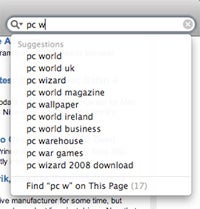
The Smart Search Field in Safari 4 is now integrated with Google Suggest, and one you start typing, the field suggests search strings. This means you'll no longer need Safari plugins, like Inquisitor, to get this kind of functionality. The Full Page Zoom feature lets users zoom in and out on a page (by using keyboard shortcuts or menus) without distorting a page's layout or losing quality. Mac users were able to perform a similar task before, but now it's available to both PC users, too.
As for speed, Apple claims Safari 4 is the world's fastest browser. While I can't verify that claim, I can say that the new browser, running JavaScript 4.2, surely feels faster and page-loading time is indeed shorter. Safari 4 also includes HTML 5, a technology that allows wed-based applications to store information locally without an Internet connection.
I really like the new version of Safari. It definitely feels faster--an improvement that alone should give headaches to Microsoft and Mozilla. Add in the other nifty features and eye-candy Safari 4 brings, like Cover Flow, and this browser should give them plenty to think about.
Even though some of Safari 4 new feature seem like they are borrowed from competitors' applications, it clearly sets itself apart as a top-class Web browser. Meanwhile, if you would like to browse the Internet, iTunes style, you can download the Safari 4 beta from Apple's site. After you do, come back and tell me what you think.
There’s a pretty good article over at GigaOM that touches on the Open vs Closed argument of technology. Specifically, it pits Android and iPhone against each other because of the obvious contrasting strategies and philosophies behind their parent companies, Google and Apple.
We can’t deny that the iPhone is wildly successful in spite of (or because of?) their closed, proprietary nature. It’s essentially the dilemma that iPhone users have been trying to find the balance to–the iPhone’s closed nature creates a clean, seamless and synergetic user experience but it often comes at the expense of the freedom of choice. You have to trust Apple enough to play nice and take a leap of faith with the direction of the iPhone.
But does that leave Google free and clear? According to GigaOM: hardly. The point has been driven before but Android isn’t married to a specific hardware form factor, any philosophical software, or well, anything, for that matter. Google has made it loud and clear that Android is open source and that it can be shaped however the user base intends to shape it. But does that openness come at the expense of the user experience? Google can’t remain fully “open” for fear of fracturing that holy grail of user experience. In a sense, GigaOM is advising Google to remain open with limits; implementing a sort of theoretically open playground that would still necessitate rules and fair play.
And though we believe Android is unique and its ceiling is higher than its competitors because of that “openness”, we tend to agree with GigaOM: that Google needs to set “parameters” with Android because mobile platforms are all about predictability and user friendliness and less about openness. In a sense, being open is good, being less than fully “open” is better.
The general public wants a phone to act and react a certain way, and without a certain amount of consistency in the platform–it can create a jagged experience that turns off many. Sure, a lot of people complain about the iPhone’s stringent app approval process but there’s certainly a lot more who are happy with just how easy and simple everything else works. It’s going to be dangerous territory for Android to tread because the tech savvy will be undoubtedly saddened if Google closes its openness but the more general public may see it as a heck of a lot more friendly.
GigaOM sums it up best:
The reality is that openness is just an attribute -– it’s not an outcome, and customers buy outcomes. They want the entire solution and they want it to work predictability. Only a tiny minority actually cares about how or why it works. It’s little wonder, then, that the two device families that have won the hearts, minds and pocketbooks of consumers, developers and service providers alike (i.e., BlackBerry and iPhone) are the most deeply integrated from a hardware, software and service layer perspective.
We know it’s a lot to digest but we want to know what do you guys think. Open or closed? Android or iPhone? Does it even matter?
Pinch Media, who provide metrics/analytics for iPhone users recently gave a presentation on “AppStore Secrets” that highlighted what they’re seeing in terms of free vs. ad supported vs. paid, and usage patterns over time.
They try to provide developers with some useful number crunching on how and when to determine if their application is “sticky” and modulate price and ad support, but they also show some things that are interesting from the user perspective:
We don’t use free apps that much. Sure, we download them by the gigabyte-full, but after a few tries, it’s buh-bye. If we pay for it, we probably need/want it more, and hence use it more.
We keep using games longer than any other type of app.
Things rings true for me. Of all the apps I’ve downloaded (and they’ve been many, free and paid), about the only ones I use consistently are casual games and communication clients (IM, Twitter, etc.) The rest of the time, I’m using built-in apps like Safari, Email, iPod, etc. And even among those “sticky” apps, when I’ve had my fill of one game, I move on to another. When a new Twitter or IM client comes out, I switch to it (and sometimes switch back and forth).
What about you? Do you stop using free apps faster than paid? And what apps do you keep using?
Seattle - The high cost and unusual design of the Apple iPhone made many very skeptical of the new device, but the iPhone is now accepted as the finest smartphone on the market today. By expanding it’s capabilities far beyond any normal phone through the use of iPhone Apps, the Apple iPhone has become a popular piece of technology.
Almost any sort of game, function or software can be loaded onto an iPhone through the App Store, and the popularity and versatility this provides has made the iPhone has made it’s competitors jealous.
In an attempt to copy the power and functionality provided by iPhone Apps, Nokia and T-Mobile have partnered to create a phone-based digital-content store for their phones known as “Ovi Apps.”
Ovi Apps is openly similar to the iPhone’s App Store, and specifically designed to compete.
This feature will be compatible with all Series 40 devices. While such copying of Apple is not unheard of, especially considering Google and Microsoft both have phone-based digital storefronts, many people are questioning if Nokia has arrived too late to the game to make a difference.
Still, Ovi Apps will add a great amount of value and functionality to Nokia Series 40 phones, and is greatly anticipated by the Nokia community.
There’s no way to emulate the iPhone on Windows, but Shaun Sullivan has the next best thing: taking a Windows build of WebKit and embedding it inside an iPhone-like Chrome. It’s not perfect, but it’s as close as Windows users are going to get for now–and is very handy for checking how your site will likely look (modulo font issues).
Our blog contains a collection articles from various sources about the latest news, gossip and updates. All you need to do to stay up to date with the latest news is to subscribe via RSS or via Email

 The iPhone’s lack of video recording was one of the more serious let-downs when Apple launched the device, and one that Apple stubbornly refused to correct with the release of the iPhone 3G. Apple may have had its reasons, but ‘lesser’ mobiles have been recording video clips for years and not being able to do the same on such a premium phone seems, well, a bit silly - particularly when the iPhone prototype apparently did come with at least video calling.




 Posts
Posts